
As 2019 comes to a close, I’d like to thank all my readers for taking a chance and reading my fiction, I hope it was worth it. I’d also like … Continue reading Publication Review 2019

As 2019 comes to a close, I’d like to thank all my readers for taking a chance and reading my fiction, I hope it was worth it. I’d also like … Continue reading Publication Review 2019
(some thoughts on my editorial role for North Bristol Writers)
The third North Bristol Writers anthology, Tales From The Graveyard, had its launch on Saturday 2nd March at the cemetery that inspired many of the featured stories. If you came along, thank you, if not, you missed a couple of relaxed and insightful hours.
Way back during October 2017, we held a storytelling evening, entitled Tales From the Crypt (yeah, I know – we’re working on originality, I promise), in the Anglican chapel at Arnos Vale Cemetery as part of the Bristol Festival of Literature, and from that sold-out evening the anthology was born.

The editorial team was agreed and consisted of myself (Acquisitions Editor), Pete Sutton (Senior and Copy Editor), and Ian Millsted (Assistant Editor, better known as Devil’s Advocate). Though one can argue how much acquisitioning is active in a submission call sent out to members of the NBW group and a few other Bristol writers, at times the use of a third editor in tipping the balance proved vital.
It was never the intention for the anthology to be horror-specific – yes, Pete and I both write in the horror genre, but there aren’t many more in the group who do – so the writers’ brief was kept suitably broad: the story must be set in a graveyard and contain a ‘weird’ element. And while the book contains ghosts, the Gothic, and a splattering of gore, it also has surrealism, pulp, humour, fantasy, and dystopia.
The content and individual word count of the accepted stories ended up so varied, that creating a TOC with enough momentum to keep pages turning filled me with a Lovecraftian dread. However, with a little research and a little more determination, the task turned out to be highly enjoyable. One could even suggest that the stories organised themselves.
The important first slot went to Kevlin Henney’s quick story for its strong opening that provides a philosophical slant which really works for, and certainly does no harm to, a book full of dead people. This bled into a murd’rous stab of fiction penned by the chilling Clare Dornan. The epics (of which there were a few) I spread throughout the book so their length would hopefully go unnoticed. The first of these, Chrissey Harrison’s fantasy action/adventure contrasts perfectly with the preceding stories. Next, two ghostly tales with child protagonists: Jon Charles’s simple tale followed by Louise Gethin’s wandering child which then ties into the gruesome wandering husband in Grace Palmer’s piece. I thought the reader now ready for a change, thus Darkfall by Dev Agarwal submerges all who feast upon it into a truly bleak dystopia. Then up for a gasp of putrid air with Amanda Staples’s creepfest, followed by the two more unusual stories of our anthology courtesy of Ken Shinn and Jay Millington. Placing both centrally highlights the differences between the two, and the rest of the book. They also act as “tentpole” stories (John Joseph Adams, source below*). Of course, what type of graveyard fiction does not contain Gothic? Behold, Chloe Headdon’s contemporary and Scott Lewis’s traditional tale. Both make an appearance in the latter part of the book allowing the reader to experience other aspects before this ubiquitous theme. Shock horror, courtesy of Grimdark queen Maria Herring, felt a natural follower-on from this, partnered with Tanwen Cooper’s seedy tale of rotten humanity. The last stories mirror the two openers, and are intended to leave positive flavours lingering on the reader’s palate; Piotr Świetlik’s humour and multiculturalism (both much needed in the world at present) and Alex Ballinger’s hopefulness. Ballinger’s ‘Messenger’ is philosophical and resonates with Henney’s opening story.
With the publication of the book, we now have a sexy little bunyip of a product that has been presented beautifully by the Typesetter (and writer), Harrison, and all wrapped up in a classic cover designed by Fabrice Mazat. And, of course, my editorship has come to an end. I’d like to thank North Bristol Writers for the opportunity to become part of this terrific book, and the insights into the other side of publishing.
*With thanks to John Joseph Adams and Cat Rambo for their articles on editing.
You can purchase Tales From The Graveyard on Amazon UK
Previous North Bristol Writers anthologies are:

The Dark Half of the Year, AmazonUK (Both Dornan and Shinn had an honourable mention from Ellen Datlow for their stories in this book.)
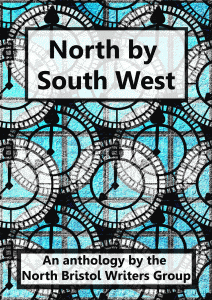
North by Southwest, AmazonUK

The launch of the North Bristol Writers’ newest anthology, Tales From The Graveyard, is from 5pm until 7pm on Saturday 2nd March at Arnos Vale Cemetery, Bristol.
There will be readings, signed copies up for grabs, and a chance to discover how we stitched together the pages of frights, desires, nightmares and tragedy into a monster!
The event page is on Facebook.
Hope to see you all there.
I attended a workshop on climate change yesterday held by the Bristol Climate Writers as part of the Bristol Festival of Literature.
As part of the course the group was asked to write two short pieces, one dystopian, one utopian. Afterward, it was generally agreed that dystopia was a lot easier to portray. Not surprising as we are surrounded daily by suffering and injustices.
Member of Bristol Climate Writers, Emma Turnbull, argued that “when we feel threatened with no perceived possibility of escape, we are at risk of experiencing trauma and developing PTSD”. With this in mind, maybe a prevalence of dystopian themes can be damaging.
If we begin to imagine utopias more, bring them into debate and discuss the possibilities, is that not positive thinking? And might that not bring about change? It’s hard to imagine in a race so scared living on a world so depleted, but it’s worth a shot. Start a conversation today.
My two workshop pieces:
Dystopia
Outside my window the last tree stands. The July sky is dappled by crisp dead leaves.
I am the only one who still comes to the office on Narrow Quay.
I am the only one.
I do no work as there is no work to be done.
Sweat replaces the tears that used to moisten the brittle rubber seal of my oxygen mask. They continued to manufacture rubber and plastics until the end because the masses continued to buy them; only the rich could afford the sustainable alternatives and they were the ones who made the plastic.
The cylinder by my legs is finally empty. A voice doesn’t need breath, just somebody to hear it.
Utopia
Their fingers pressed those buttons years back and dystopia died along with the many.
I may not have mastered utopias yet, but I’m going to keep trying.
Nash

Another collaboration discussed this week was a series of short stories exploring tunnels and familiar strangers, with the exuberant master of tales, Joffre White, author of the Frog Series and Earthland. I’m looking forward to unearthing some mysteries for your entertainment with this collection.

I read in The Guardian on Friday that print sales for literary fiction have remained low since they plummeted in 2010. This ‘crisis’, highlighted in a report commissioned by the Arts Council England (ACE), has the same Council considering to fund this publishing genre.
It would be a mistake, I think, to assume that other genres only reflect society rather than examine it, or do not have anything worthwhile to say, and therefore don’t merit support.
Should we not question ACE’s literature director’s reported comment, “… we are saying that there is something so unique and important and necessary and fundamental about literary fiction in particular, that we need to focus on it and support it.”?
Shouldn’t ACE concentrate on promoting literacy in schools, or reading in adulthood, with the aim to allow the reader, not ACE, to support the authors of literary fiction or any other genre?

I have just received a rough recording of my story, We Are Gathered. It was recorded live in the Anglican chapel at Arnos Vale Cemetery on a stormy October evening, … Continue reading We Are Gathered – audio version

As Ophelia waved her tail in farewell and our very own Brian approached with all the stormy power its name suggests, our Tales From The Graveyard, the proposed tour of Arnos Vale with accompanying fiction, was limited to the Anglican chapel that crowns the cemetery’s hill.
The austerity of the building combined with candlelight shadows was the perfect gothic setting for our readings of the macabre and the horrible. And with an added soundman, Rich Jeffery, there maybe an audio book of the event in the future.
Among the North Bristol Writers that took part were:
Pete Sutton, Maria Herring who was reading a story by Kevlin Henney, Chrissey Harrison, Justin Newland, Clare Dornan, Jay Millington, Ian Millsted, and Piotr Sweitlik,
With the poet B Adriaens reading my contribution this ghoulish evening was concluded.
With thanks to the Arnos Vale staff – great coffee, by the way – and, of course, our audience – I hope you enjoyed it as much as we did!
Look out for the Tales From The Graveyard print anthology in 2018
Come along to Arnos Vale Cemetery in Bristol on October 19th, when my story, We Are Gathered, will be read among the headstones. Other members of North Bristol Writers will also be reading their new work. Visit the event page on the AVC website for more details.
 Come along to Arnos Vale Cemetery in Bristol on October 19th, when my story, We Are Gathered, will be read among the headstones. Other members of North Bristol Writers will also be reading their new work. Visit the event page on the AVC website for more details.
Took my son for a jolly in Arnos Vale Cemetery today – I know, he’s a lucky lad, right?
My work in progress, We Are Gathered, will hopefully be performed here in October, so I wanted to get a feel for the place. After an explore through the shadows and having collected over a hundred and twenty photos (ones featured salvaged from the mass of photobombings), I have enough to start on the second draft.
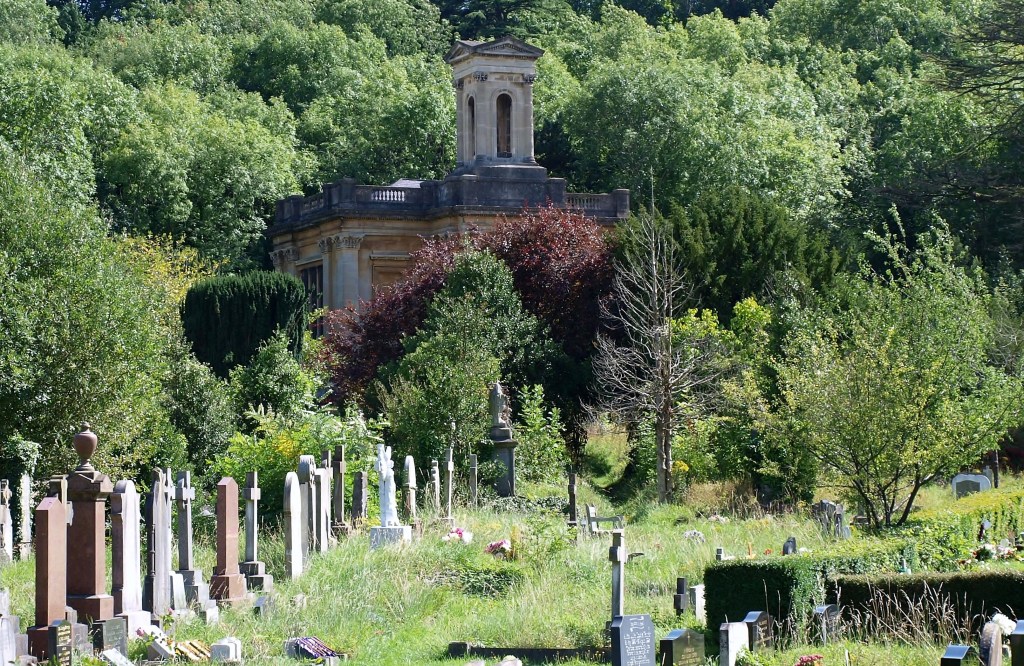

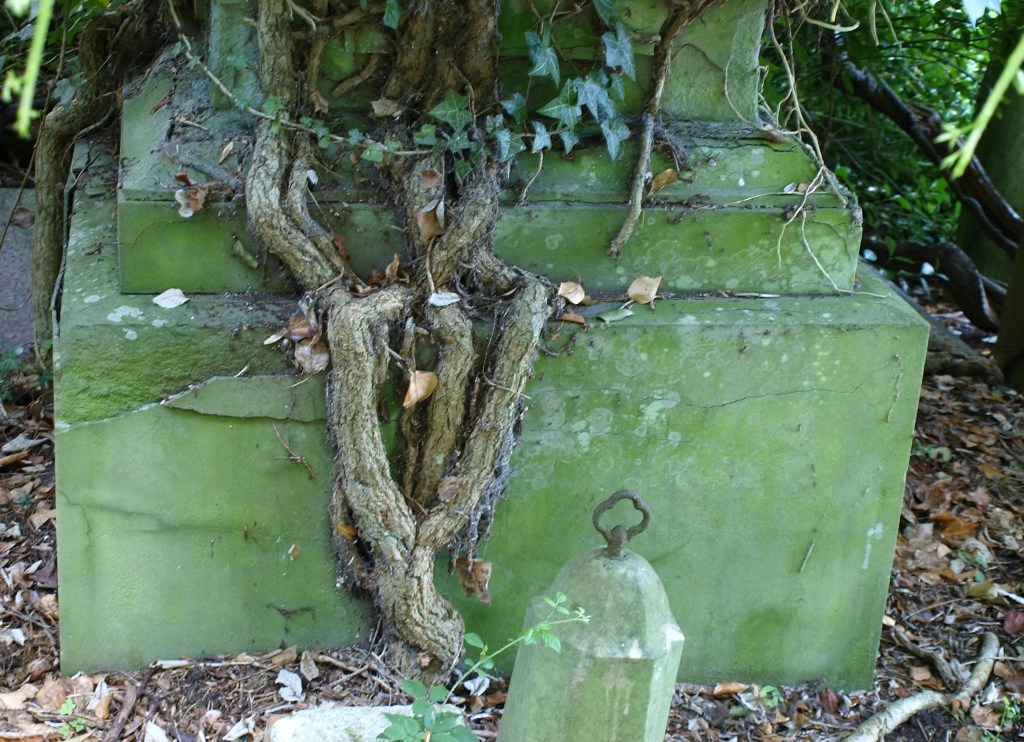
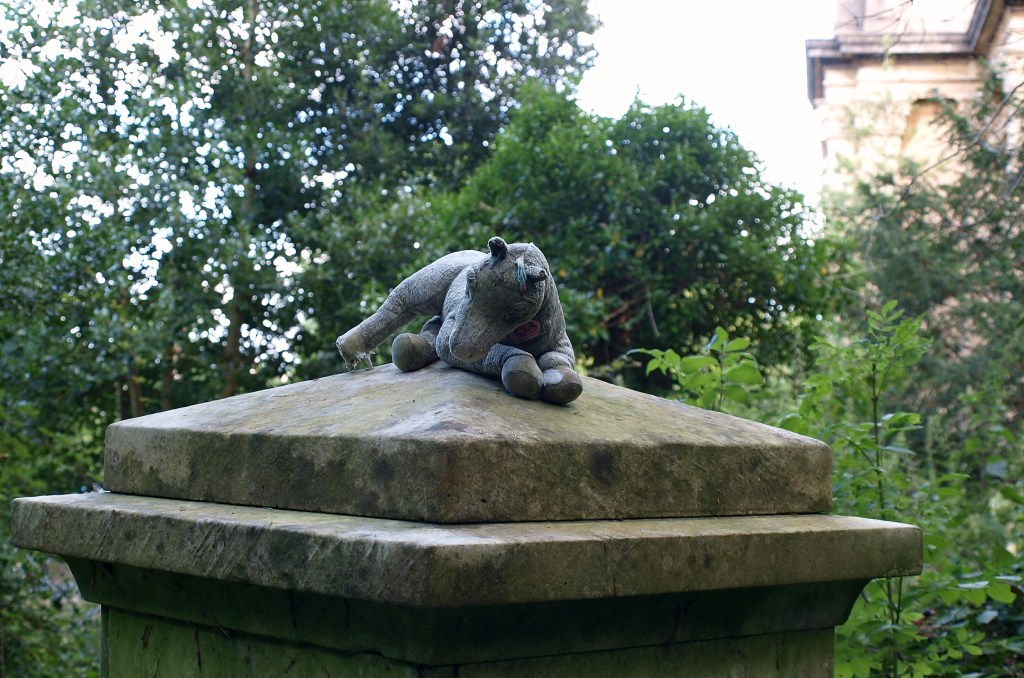

Arnos Vale is a forty-five acre Victorian Garden Cemetery alive with nature trails, a Forest school, guided tours, hidden symbols, underground tunnels and weddings, in the heart of the vibrant UK city of Bristol. For more info, visit www.arnosvale.org
 Eric Nash