
Paul has produced a few A4 prints of the wrapround artwork he created for my collection, Corpse Road Blues.

These are signed and printed on 250gsm paper and are selling for £20. If you’d like one, please contact Paul via his website.
Paul has produced a few A4 prints of the wrapround artwork he created for my collection, Corpse Road Blues.
These are signed and printed on 250gsm paper and are selling for £20. If you’d like one, please contact Paul via his website.
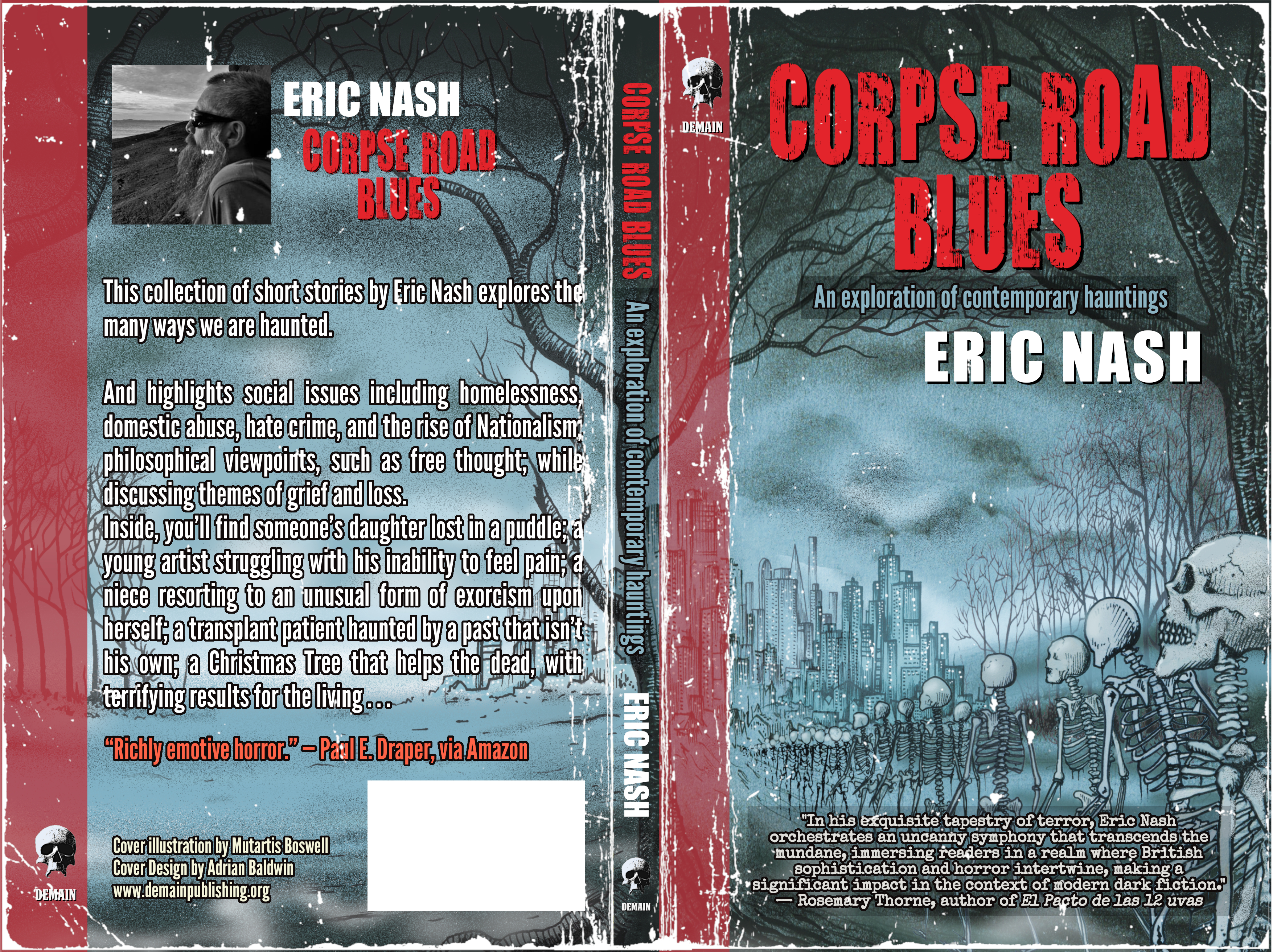
Corpse Road Blues, my first short story collection, is available in both paperback and ebook formats.
Fifteen original and previously published stories that explore what it means to be haunted; fifteen spectres, wraiths and shades lost on the old corpse road; fifteen chances to find peace.
“This is a fine collection of short dark tales. Eric Nash balances the grim with the soulful as real emotion interweaves shadows and elements as disparate as Greek mythology, marginalised community bigotry, voyeurism, body horror and rural folk creepiness.” Paul E Draper, author of Black Gate Tales.
“…so brilliantly horrible, it’s left some mental images that are going to be lingering for a very long time! I’m having to take a bit of a breather in-between each story, they really do pack a punch. But that’s no bad thing, writing this good should be savoured rather than all gobbled down in one go.” Steph Lay (author of Taking the Red Ways).
The paperback comes with a vintage wraparound cover designed by Adrian Baldwin, illustated by Mutartis Boswell. It is published by Demain Publishing.
Bonus material – if you’re a fan of origin stories, then there’s a series of posts on the blog that discuss the inspiration for each story in the collection. There’s also a Spotify playlist dedicated to the book, and if you have your own choice of songs that fit the stories, let me know, I’ll add them to the playlist.
You read a book, you enjoy it, you may recommend it to your friends, you may go on social media and say, ‘Hey, this is a good book!”, who knows, you might even reach out directly to the author and let them know. I’ve always shied away from doing the latter, believing they don’t want to hear from some random person. I think I may have been mistaken.
I remembered how much effort and time goes into creating a story, a collection, or a novel; how much of themselves a writer weaves into each sentence to bring the tale to life. And this is true for any type of artist, any creative endeavour.
Then they put it out there for public consumption. A natural progression, but also a brave act. I don’t think it matters if it’s a writer published by one of the top five, a self-published author, or the person who just sold their first story to a fresh new magazine, they all doubt themselves. I know of authors who can’t read any of their published material because they can see flaws in the work.
Feedback, along with good reviews and star-ratings on platforms like Amazon or other sellers, on Goodreads and The StoryGraph are vital to sales. And the cynical may say sales is what it’s all about.
But getting praise on a job well-done?
Letting the writer know, directly or indirectly, that they’ve moved a reader in some way?
It’s that which keeps a writer going, which of course means…
Positive feedback saves lives. The lives of tales yet to be told, and books still unwritten.

Thank you so much!
to anyone who has bought my short story collection, Corpse Road Blues: an exploration of contemporary hauntings.
to anyone waiting for the paperback realease in April.
to anyone who has bought any of the books that feature my short stories.
and if you’ve reached out to let me know how much you liked Corpse Road Blues or if you left a review, please know that you’ve helped me continue to write.

Aglaope’s Song is Silence Now is the last story in my collection, Corpse Road Blues: an exploration of contemporary hauntings (pub. Demain Publishing). The ebook is out now, and thank you very much to those who have already bought the book; I do hope you’ve enjoyed it. If you’re holding on for the paperback, we’re looking at April. A publication date will be shared when we know one, so keep an eye on the blog, or on mine and Demain Publishing’s socials, for news. Hopefully, I’ll be putting together a few extras in time for that date as well.
So, Aglaope’s Song is Silence Now. What a ghastly tale!
Aglaope is one of the Sirens in Greek mythology. Originally, the sirens represented the dangers of the sea, but have since become symbolic of the supposed dangers of lust and temptation – and the ‘female temptress’.
When the #MeToo movement went viral, it highlighted the shocking extent of sexual harassment in society. I knew I wanted to incorporate this into a story, possibly using the Siren myth somehow, but wasn’t sure where to start.
It took another unrelated event – overhearing a work colleague recalling an incident he’d experienced – for Aglaope’s Song… to make it onto the page. After driving home from work late one evening, my work colleague turned off the engine and remained in their car, taking a moment to gather their thoughts and process the events of the day before going into the house to greet their partner and children. About five minutes in, they noticed a man walking along the residential street toward him, checking each car door as he passed. After some moments had passed, enough to be confident of the stranger’s intentions, my colleague made to confront the man, but as soon as they exited the car the man spotted them and ran off. Somewhat surprisingly, the main protagonist in Aglaope’s Song is Silence Now is based on that opportunist thief skulking in the shadows. What does the night and a Siren offer this man?
Find out in Corpse Road Blues.
As always, thanks for reading.
Nash

The penultimate story in Corpse Road Blues from Demain Publishing is a story of contrasts. Within This House uses a combination of diary form and present tense narration to create a more traditional ghost story which I used with a dystopian setting. I also tried to combine real-life horror – both alluded to and on the page – with supernatural horrors.
On her website, horror writer Sarah Budd (author of Enter the Darkness, pub. Brigids Gate Press), wrote that “to really scare your readers, you need to write about your own fears”. Like many, one of mine is the continually de-stabilising world (both politically and environmentally) that our children will inherit. A fear Within This House explores. The story is a response to the present political landscape in my country, in particular, the hostile environment that exists, and sadly, shows no signs of abating. Writing fiction can be a cathartic experience. If I can take you, the reader, along for the ride, so much the better.
Once again, if you’d like to read Within this House, and the other stories, Corpse Road Blues is available here.
Back in 2007, twenty-year-old Sophie Lancaster and her boyfriend were brutally beaten on the streets of Britain. Sophie later died of her injuries. They were attacked for being different, for being part of a subculture. After this tragedy, her mother started the Sophie Lancaster Foundation to “combat prejudice and intolerance” and has been fighting tirelessly against hate crime. They do a lot of excellent work in schools and the community. I think about Sophie and the Foundation a lot, especially as I still consider myself part of that subculture, and as a teenager experienced some of that hatred.
Police Recorded Hate Crime figures have increased by over 100,000 in the decade between 2013 and 2023 (source link). Whether it’s for being a member of a subculture, like Sophie, being a member of the LGBTQ+ community, or being a different race or religion, victims of hate crime are everywhere. We have a problem. Be kind. Educate yourself.
A Safe Place is a reaction.
To know more visit Stop Hate UK, the LGBT Foundation, The Sophie Lancaster Foundation.
Not sure if I’ve mentioned this before, but my collection Corpse Road Blues is out now from Demain Publishing. The fifteen stories in the book look at what it means to be haunted; what drives an apparition to cling to this earth, and those still living; and the ways to be rid of a tortured soul if that’s what we truly desire. Thanks for sticking with me.
If we had another shot at life, would we grab it? Is it possible for our consciousness to live on after death? If we have souls, would they mourn their expired bodies? We’re nearly at the last three stories, but first we have The Body in Deer Leap Woods. A truly scary tale – I hope – waiting to be unearthed.
Whilst researching another project online, I spotted pictures of a curious and evocative statue entitled The Shout, that’s housed in Margam Country Park. The artist is Glynn Williams, and the statue depicts a mother holding her child.
The statue had such an impact on me that it inspired The Body in Deer Leap Woods. The story concentrates on the emotion that the statue captures, rather than the scenario. In Deer Leap Woods, a soul (or a consciousness) has replaced the mother figure; its empty body the child that the mother holds.
At the same time as the story was brewing in my head, I’d been taking regular walks near my home in a patch of ancient woodland known as Vallis Vale. On one of those trips, I spied a clearing through the mossy branches, and in my mind, clear as day, the statue sat there among the fungi and ferns. The soul had chosen the setting—who was I to argue?
If you’d like to read the story, and the others that I’ve talked about, it’s here.
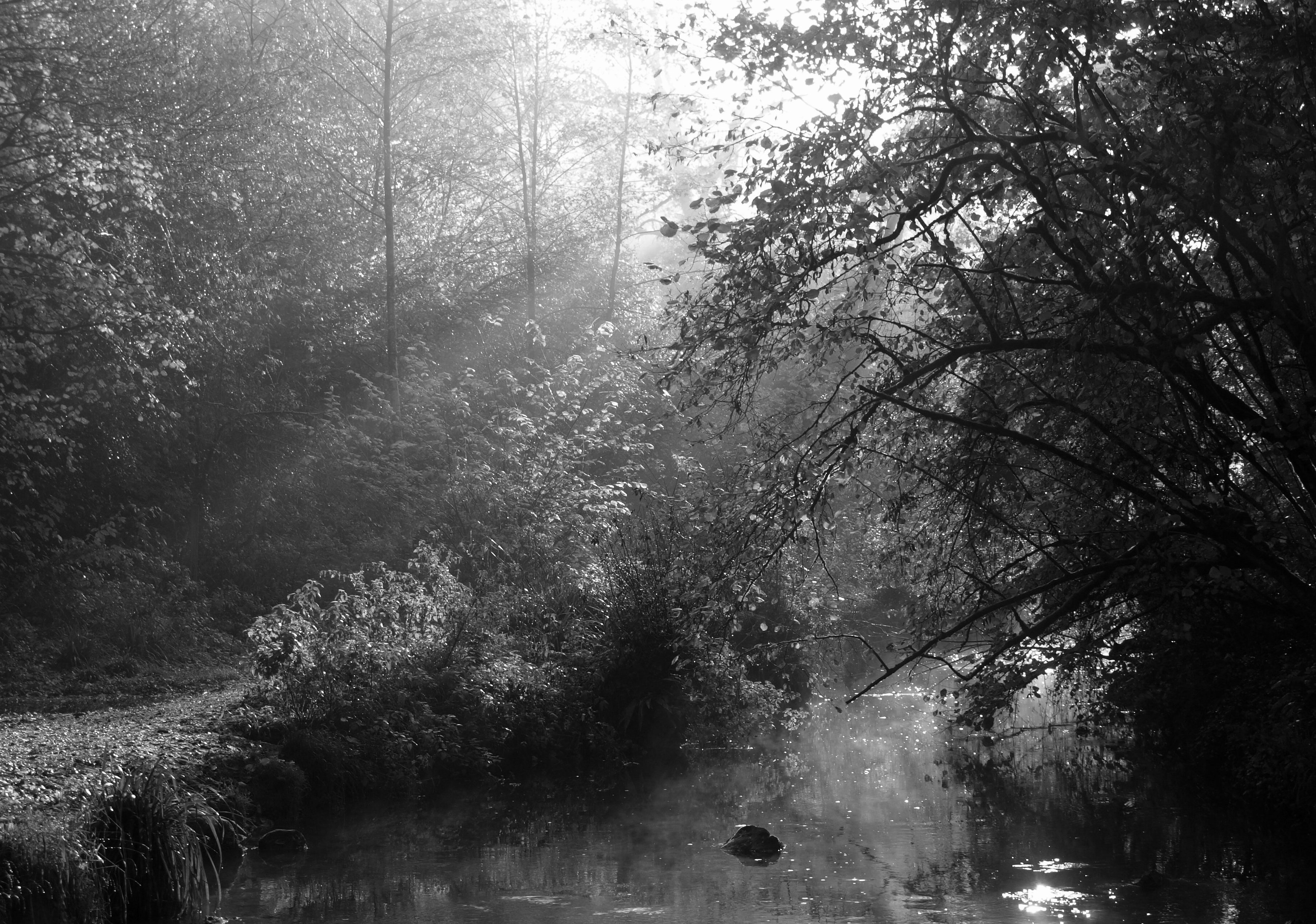
Let’s climb to the top of Midwinter Hill.
In the book, The Hidden Life of Trees (pub. Greystone Books, 2015), Peter Wohlleben talks about how trees are connected to one another: that beeches for instance “are capable of friendship and go so far as to feed each other”; trees become friends that “communicate by means of olfactory, visual, and electrical signals”, and “warn each other using chemical signals sent through the fungal networks around their root tips.” Despite being an enthralling read, this didn’t really surprise me – after all, the entirety of the natural world is interconnected – but with every page I turned, something stirred in the rich soil of my imagination.
By writing these short introductions, it struck me how there’s usually at least two unrelated things that unite to create my stories. For instance, while reading Wohlleben’s book, I overheard a work colleague discuss his plans for the coming Christmas. His mother had passed away that year, and, as she had loved the holiday so much, the family were keen that she still took part in that year’s celebrations. They agreed that they would decorate her grave with a Christmas tree.
Before I knew it, On Midwinter Hill was drafted. Since then, the story has had multiple title changes, been a tale told in reverse, then finally the version found in the book.
If you’d like to read it, and the other stories, you can buy Corpse Road Blues here.

One of my favourite areas in London that I’ve found so far is Southbank, along the river Thames. This cultural hotspot and tourist thoroughfare bustles with the sounds and sights of buskers and street performers, the area boasts theatres, an open-air book market, and a sheltered skatepark. It’s the setting of Wounds are Lips Waiting to be Kissed, the seventh ghost story in my collection, Corpse Road Blues, out now from Demain Publishing.
The main character, Swann, savours the sights along Southbank on his way to meet up with his girlfriend. He pauses at each street performer, mingling with the crowd, but what holds his attention is the mysterious living statue that appears to be following him.
In his article, Finding Beauty in Horror: Objective Observation and Personal Taste, writer and artist, Chandler Bullock says that “what makes horror able to be beautiful is the genre’s profound ability to make us feel.” In Wounds are Lips Waiting to be Kissed I was looking for contrast, to look at beauty and horror together, like what I feel Poppy Z. Brite explores in Exquisite Corpse, or Stephen King in his exceptional story, Herman Wouk is Still Alive (in the collection, The Bazaar of Bad Dreams. Both certainly ‘make us feel’.
Wounds was about capturing the magic of Southbank, while doing a deep dive into one person’s pain. It is both a love story and a body horror, along with a haunting, and remains a tale that is close to my heart.
If you’d like to read the story, you can buy Corpse Road Blues here.

 Eric Nash